2940 NM ABLATIVE RESURFACING · ARNPRIOR + OTTAWA VALLEY

Fotona Er:YAG Laser Resurfacing Near Ottawa


Precision resurfacing for sun damage, fine lines, uneven texture, enlarged pores and acne scarring.
Fotona’s 2940 nm Er laser allows us to precisely remove controlled amounts of damaged skin while stimulating a repair and remodelling response underneath.

Treatment can be customized from lighter superficial resurfacing to fractional or more intensive ablative resurfacing, depending on your skin, your goals and how much recovery time makes sense for you.

The short answer

Er:YAG is not one treatment, it is three levels of the same laser. The 2940 nm wavelength is absorbed by water in the skin, so the depth can be dialled to the concern rather than running one intensity on every face. You and Stacey pick the level from what needs correcting and how much recovery time you can give it.

Best for
Rough or damaged texture, sun damage, fine lines and some acne scars
Light renewal
$500, the shortest recovery of the three
Corrective
$750, when surface renewal is not enough
Advanced
$1,000, the most correction and the most recovery
How Fotona Er:YAG Works

Precision, Layer by Layer.

Er:YAG is an ablative resurfacing laser designed to create controlled skin renewal. Because treatment depth, density and delivery can be adjusted, resurfacing can be customized to the concern being treated rather than using one intensity for every skin.

2940 nm Er:YAG
The 2940 nm wavelength is strongly absorbed by water in the skin, making it particularly well suited to controlled ablation and resurfacing. By targeting water-containing tissue, Er:YAG can remove selected layers of damaged skin while allowing treatment intensity to be tailored to the desired level of correction.
01
Surface Renewal

Superficial Resurfacing

Controlled surface ablation can be used to address roughness, dullness and superficial photodamage while refreshing the outermost layers of the skin.

02
Fractional Treatment

Fractional Er:YAG

Microscopic areas of ablative treatment are created while portions of surrounding skin remain untreated. This approach can be selected when targeting concerns such as texture, fine lines, enlarged pores and selected acne scars.

03
Advanced Resurfacing

Deeper Ablative Resurfacing

When more established photodamage, wrinkles or textural change require greater correction, treatment intensity can be increased. More intensive resurfacing also means a more significant recovery period.

The goal is not to choose the strongest setting.
It is to choose the right depth for your skin.
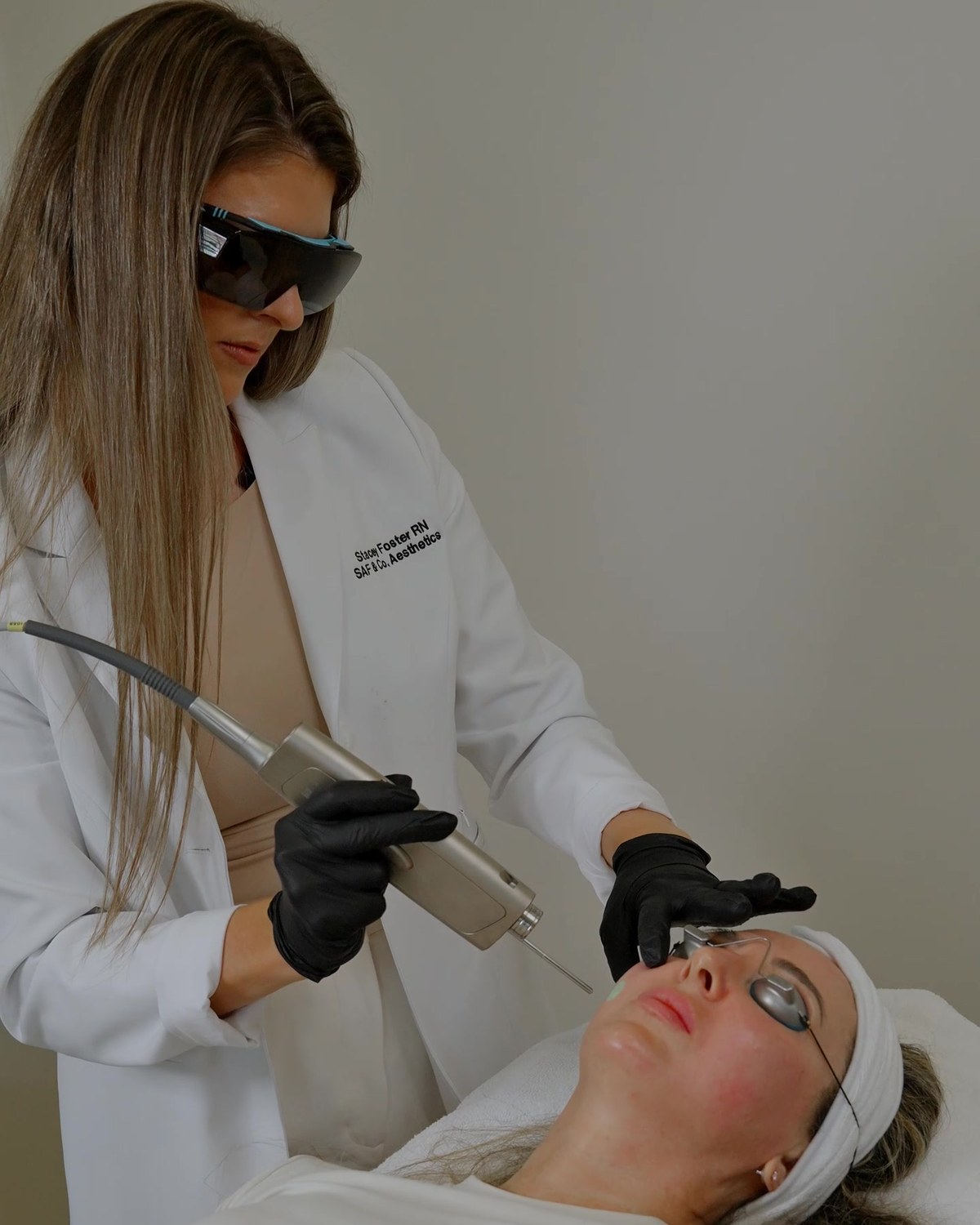
Fotona laser resurfacing treatment in progress at Arnprior Med Spa

Fotona Er:YAG 2940 nm Laser Resurfacing

Ablative laser resurfacing. Customized by depth.

Fotona Er:YAG uses a 2940 nm wavelength with a very high affinity for water in the skin. This allows the laser to remove controlled amounts of damaged tissue with micron-level precision.

Unlike a laser with one fixed treatment intensity, Er:YAG resurfacing can be adjusted across a broad spectrum. Treatment may involve lighter superficial ablation, fractional resurfacing or deeper full-field correction depending on what we are trying to change.

Fotona’s platform supports both fractional and full-field resurfacing, as well as different balances between ablation and thermal effect.

best for:

  • Sun damage
  • Enlarged pores
  • Uneven skin texture
  • Acne scarring
  • Fine lines + wrinkles
  • Rough or weathered skin
  • Perioral wrinkles
  • Periorbital wrinkles
  • Advanced surface renewal

RECOVERY
Variable, determined by resurfacing depth and intensity.

Lighter treatments may involve redness, dryness and visible peeling for several days.

More intensive fractional or full-field ablative resurfacing can involve more significant redness, swelling, peeling and a longer recovery period.

Recovery varies significantly with treatment intensity; after stronger resurfacing, residual redness may persist after the initial peeling phase has resolved.

Fotona Er:YAG · 2940 nm Ablative Resurfacing

Three Levels of Resurfacing

Er:YAG isn’t one fixed treatment. The depth and intensity can be customized according to what we are trying to improve, how much correction your skin requires and the amount of recovery time that works for you.

01
Light Surface Renewal

Superficial Er:YAG

A lighter ablative resurfacing treatment designed to remove a controlled amount of damaged surface tissue and refresh overall skin quality without choosing a deeper level of correction.
Treatment Price $500
Best Considered For
  • Dull or rough skin
  • Early sun damage
  • Superficial textural change
  • Fine surface lines
  • Overall skin renewal
Downtime

Typically the lightest recovery of the three treatment levels. Redness, dryness, sensitivity and visible flaking or peeling may occur as the treated surface renews.

02
Corrective Resurfacing

Medium-Depth Er:YAG

A more corrective resurfacing treatment when superficial renewal isn’t enough. Treatment depth, density and delivery pattern can be adjusted according to the concern, including fractional treatment when appropriate.
Treatment Price $750
Best Considered For
  • More noticeable uneven texture
  • Fine lines and early wrinkles
  • Enlarged-looking pores
  • Selected acne scars
  • More established photodamage
Downtime

Expect a more visible recovery than superficial resurfacing. Redness, swelling, dryness and peeling can occur, with recovery varying according to treatment depth and density.

03
Advanced Correction

Deeper Ablative Er:YAG

A more intensive resurfacing approach for skin requiring greater surface correction. Increased treatment depth creates a more significant healing response and therefore requires a greater commitment to recovery.
Treatment Price $1,000
Best Considered For
  • More advanced sun damage
  • Deeper lines and wrinkles
  • More significant surface irregularity
  • Established textural change
  • More intensive skin renewal
Downtime

This level involves the most significant recovery. Redness, swelling, sensitivity, peeling and ongoing visible redness may occur as the skin heals. Expected recovery is reviewed with you before treatment.

The most expensive treatment is not automatically the right treatment.

Your resurfacing depth is selected according to your skin, the concern being treated and the amount of downtime you’re comfortable with. You do not need to decide which level to book before your consultation.

Choosing a Resurfacing Laser

Which Laser Is Right for Your Skin?

Different wavelengths create different effects within the skin. We use multiple resurfacing technologies so treatment can be selected according to the concern, rather than trying to make one laser do everything.

1927 nm

LaseMD Ultra

Non-Ablative Fractional Thulium
Primary Focus

Pigmentation, photodamage and uneven tone.

Best Considered For
  • Sun damage
  • Uneven pigmentation
  • Brown spots
  • Overall tone
  • Early photoaging
Surface Ablation

No, non-ablative fractional treatment.

Recovery

Generally lighter than ablative resurfacing, although redness, dryness and visible shedding can occur.

Explore LaseMD Ultra →
1550 nm

Mosaic 3D

Non-Ablative Fractional Er:Glass
Primary Focus

Texture and fractional dermal remodelling.

Best Considered For
  • Uneven texture
  • Enlarged-looking pores
  • Fine lines
  • Selected acne scars
  • Collagen remodelling
Surface Ablation

No, it creates fractional thermal treatment below the surface.

Recovery

Variable depending on treatment density and intensity, without full-field surface ablation.

Explore Mosaic 3D →
10,600 nm

CO₂ Resurfacing

Ablative CO₂ Laser
Primary Focus

More intensive ablative and thermal correction.

Best Considered For
  • More advanced wrinkles
  • Significant texture
  • Selected acne scars
  • Advanced photodamage
  • Deeper resurfacing needs
Surface Ablation

Yes, with a greater surrounding thermal component than Er:YAG.

Recovery

Typically more significant when used for deeper corrective resurfacing.

Explore CO₂ Resurfacing →
Stronger is not automatically better.

The right resurfacing treatment depends on what we are treating, where the concern sits within the skin, your pigment history, previous treatments and how much downtime you are comfortable with. You do not need to decide which laser to book yourself.

Why Clients Travel From Ottawa for Er:YAG Laser Resurfacing

You are not limited to one resurfacing laser

The right laser depends on the skin concern.
The treatment is chosen for your skin, not because it’s the only laser available.

Your skin is assessed before anything is treated

You don’t have to choose the laser yourself.
We determine what needs to be treated, how deeply and with which technology.

A registered nurse with laser safety training treats you

Advanced training across CO₂, Er:YAG, 1550 nm, 1927 nm and vascular laser technologies.

You are looked after from skin prep through recovery

Your plan includes preparation, downtime expectations and aftercare, not just the procedure itself.

Other resurfacing options

This page names other lasers because the right one depends on the concern. Here is where each of them sits.

Frequently Asked Questions

Fotona Er:YAG is an ablative laser resurfacing treatment using a 2940 nm wavelength, which is strongly absorbed by water in the skin. This allows very controlled removal of damaged skin tissue and makes it possible to precisely adjust the degree of resurfacing.

What makes Er:YAG especially useful is its versatility. Treatment does not have to mean one aggressive procedure. Depending on your skin and goals, it may range from more superficial resurfacing to fractional treatment or more intensive ablative resurfacing.

For patients, this means we can adjust the treatment to the problem rather than forcing every concern into the same protocol. Fotona describes its Er:YAG platform as capable of fractional and full-field resurfacing across a range of treatment depths and thermal effects.

Er:YAG resurfacing is most useful when the problem involves damaged or irregular skin texture.

Depending on the treatment approach, it may be considered for:

  • sun damage and photodamage
  • fine lines and wrinkles
  • rough or uneven texture
  • enlarged-looking pores
  • selected acne scars
  • superficial irregularities
  • overall skin quality and visible aging

The important distinction is that not every brown spot, scar or wrinkle should automatically be resurfaced. Pigmentation, for example, can have very different causes. During consultation we first determine what we are actually looking at, because that affects which wavelength and treatment strategy make sense.

It can be, but Er:YAG is better thought of as a highly adjustable resurfacing wavelength rather than simply a “strong” laser.

A superficial Er:YAG treatment and a deeper ablative Er:YAG resurfacing procedure are very different experiences. Treatment depth, density, pulse characteristics and thermal effect can all influence both the result and recovery.

That is why I don’t believe in choosing a treatment simply because it is the strongest option available.

The goal is to use enough treatment to meaningfully address the concern, without creating unnecessary downtime or risk.

Some Er:YAG treatments can create a superficial peel-like resurfacing effect, but Er:YAG is capable of much more than a superficial laser peel.

At lighter settings, treatment may focus primarily on surface renewal. Er:YAG can also be delivered fractionally or used for deeper ablative resurfacing when more significant texture or photodamage needs to be addressed.

For this reason, I prefer describing the treatment by its depth and purpose rather than using one generic “laser peel” label.

Both are ablative resurfacing lasers, but they interact with tissue differently.

Fotona Er:YAG uses 2940 nm, which has very strong absorption in water and allows precise ablation with comparatively limited residual thermal effect when used in shorter pulse modes.

CO₂ laser uses 10,600 nm and typically produces a greater zone of thermal coagulation around the ablated tissue.

That does not mean one is automatically better than the other.

CO₂ may be appropriate when I want a stronger combination of ablation and thermal remodelling. Er:YAG can be particularly valuable when I want very precise control over tissue removal and the amount of residual heat.

Neither laser is automatically better for every acne scar.

Acne scars can include rolling scars, boxcar scars, ice-pick scars, tethering and combinations of several scar types. The depth and architecture of the scar matter.

Fractional ablative resurfacing can be useful for selected textural acne scars, but some scars may benefit from a combination approach rather than simply increasing laser intensity.

This is one reason acne-scar consultations are important: we are treating scar anatomy, not just the fact that the patient has “acne scars.”

Both platforms use the 2940 nm Er:YAG wavelength, so they share the fundamental advantage of strong water absorption and highly precise ablative resurfacing.

The difference lies largely in how each manufacturer controls the laser pulse and tissue effect.

Sciton’s Contour TRL, the Tunable Resurfacing Laser, is a dedicated dual-mode Er:YAG resurfacing system. It is designed to allow the provider to independently control the depth of tissue ablation and the depth of thermal coagulation. Sciton describes this as allowing anything from relatively “cold” Er:YAG ablation to a more thermally coagulative resurfacing effect.

Fotona’s Er:YAG platform also provides significant control over the balance between ablation and thermal effect through its pulse technology and can be used for fractional, superficial and deeper resurfacing approaches.

From a patient’s perspective, both are sophisticated Er:YAG resurfacing technologies.

I would not tell a patient that one brand name automatically produces a better result. Provider assessment, treatment parameters, appropriate patient selection, skin preparation and aftercare remain extremely important.

They share the 2940 nm Er:YAG wavelength, but the treatment platforms and delivery strategies are not identical.

HALO TRIBRID incorporates 2940 nm alongside 1927 nm and 1470 nm wavelengths, allowing simultaneous or combined treatment of superficial texture, pigment and deeper dermal targets.

Fotona’s Er:YAG platform can instead be used as a dedicated resurfacing tool across different depths and treatment patterns.

This is why comparing treatments only by wavelength can be misleading.

Wavelength tells us what the laser energy interacts with. Treatment design tells us what we actually do with it.

Traditional HALO is a hybrid fractional laser that combines ablative 2940 nm Er:YAG with non-ablative 1470 nm energy in microscopic treatment zones.

Fotona Er:YAG resurfacing can be used specifically for ablative resurfacing at 2940 nm and can be adjusted according to the desired resurfacing depth and treatment pattern.

If a patient is mainly concerned about texture and controlled ablation, Er:YAG resurfacing may make sense. If multiple depths or chromophore targets need to be addressed, a different or combined treatment approach may make more sense.

The consultation is where we determine that.

These are very different treatments.

LaseMD Ultra uses a 1927 nm thulium wavelength and is particularly useful when the treatment goal involves photodamage, dyschromia and more superficial pigment-related concerns.

Fotona Er:YAG uses 2940 nm and is an ablative resurfacing wavelength. Its role is more directly related to controlled removal and renewal of damaged skin tissue.

So if I am primarily thinking:

pigmentation and photodamage → Ultra may be considered

whereas:

ablative correction of surface texture and damaged tissue → Er:YAG may be considered

Sometimes skin needs both pigment correction and texture correction, but that doesn’t necessarily mean both should be performed on the same day.

Mosaic and Er:YAG approach resurfacing very differently.

Mosaic uses a 1550 nm non-ablative fractional wavelength. Rather than removing the surface of the skin, it creates fractional thermal treatment zones below the surface to stimulate remodelling.

Er:YAG at 2940 nm is ablative, meaning it can physically remove controlled amounts of tissue.

That makes Mosaic particularly useful when I want fractional dermal remodelling without ablating the entire treated surface, while Er:YAG may make more sense when controlled surface ablation is an important part of the treatment.

Neither replaces the other.

No, and this is one of the most important reasons to have your skin assessed first.

Not all pigmentation behaves the same way.

A discrete sun spot, diffuse photodamage, post-inflammatory pigmentation and melasma may look similar to patients but have very different biology and treatment considerations.

Melasma in particular requires a thoughtful approach because aggressive treatment is not necessarily better treatment.

If pigmentation is your main concern, we first determine what type of pigment we are treating before deciding whether resurfacing belongs in the plan at all.

Any procedure that creates inflammation in the skin has the potential to contribute to post-inflammatory hyperpigmentation in susceptible patients.

Risk varies with skin type, treatment intensity, sun exposure, pigment history and other factors.

That does not mean pigmented skin can never be resurfaced. It means resurfacing should be appropriately selected, prepared and performed.

If I think the risk outweighs the benefit, I would rather recommend another approach than perform a laser simply because someone came in asking for it.

There is no single downtime number because Er:YAG treatment intensity can vary considerably.

A light superficial treatment may involve redness, dryness and shedding.

Fractional ablative resurfacing generally creates more visible recovery.

Deeper ablative resurfacing can involve substantially more healing and a longer period of redness.

During consultation we discuss not only the result you want, but also:

How much downtime can you realistically take?

That answer can influence which treatment I recommend.

Visible dryness, flaking or peeling can occur after ablative resurfacing because the skin has been deliberately treated and is undergoing repair.

However, more peeling does not automatically mean a better treatment.

The endpoint is appropriate tissue treatment and healing, not trying to create the most dramatic recovery possible.

Comfort depends on treatment depth and intensity.

More superficial treatments may require relatively modest comfort measures, whereas deeper ablative resurfacing requires a more comprehensive comfort plan.

We discuss this before booking the procedure so you know what to expect rather than discovering it on treatment day.

It depends on how aggressively each session is performed and what we are treating.

Lighter resurfacing may make sense as a series.

A more intensive ablative treatment may be performed far less frequently.

I would rather determine the appropriate treatment intensity first than sell a predetermined number of sessions before assessing the skin.

There are two phases of improvement.

The first is surface renewal, which becomes visible as the treated skin heals.

The second is remodelling, which occurs more gradually as the skin continues its repair response.

This means the way your skin looks once it finishes peeling is not necessarily the final result.

Resurfacing can improve fine lines and overall skin quality and can contribute to tissue remodelling, but I would not position Er:YAG resurfacing as a substitute for surgical lifting.

If laxity rather than texture is the dominant concern, we need to identify that during consultation because another technology or treatment strategy may be more appropriate.

This distinction matters because a wrinkle caused mainly by damaged skin and a fold caused by structural laxity are not the same problem.

Laser resurfacing is not selected simply according to age.

The relevant questions are:

What is the concern?
What does the skin actually show?
Can it be improved more appropriately another way?
Does the expected benefit justify the treatment and downtime?

Someone with significant acne scarring may have a legitimate resurfacing indication at a younger age, while another person may benefit more from skincare or a less aggressive treatment.

Age alone does not determine candidacy either.

Skin condition, medical history, healing capacity, medications, previous procedures, treatment goals and the nature of the concern all matter.

A consultation lets us determine whether resurfacing is appropriate and whether the expected improvement matches what you are hoping to achieve.

Because choosing the correct laser is part of the treatment.

Two patients can both say they want to improve “brown spots and wrinkles” and need completely different plans.

During consultation, we assess:

  • what is actually causing the visible concern
  • pigmentation and redness
  • texture and scarring
  • previous treatments
  • current skincare
  • skin response and history
  • treatment goals
  • tolerance for downtime
  • whether another technology would make more sense

You shouldn’t have to diagnose your own skin or decide between Er:YAG, CO₂, Mosaic and LaseMD Ultra from a website.

That’s our job.

Your consultation is designed to leave you with a plan, not another list of treatments to choose from.

We review your skin concerns, history, previous treatments, skincare and goals. Where appropriate, VISIA imaging can help us evaluate features such as pigmentation, redness, UV-related damage, pores and texture.

We then discuss what I would address first, which technologies may be appropriate, the expected recovery and whether skin preparation is recommended beforehand.

Sometimes the recommendation is Er:YAG.

Sometimes it is CO₂, Mosaic, LaseMD Ultra, vascular laser, skincare or a staged combination.

And sometimes the right answer is not to laser the skin yet.

That is exactly why the assessment comes first.

You don’t need to decide between Fotona Er:YAG, CO₂, Mosaic, LaseMD Ultra, HALO-style resurfacing or another technology before you book.

Start with the concern.

We’ll determine what layer of the skin needs to be treated, how much correction is appropriate and how much downtime makes sense for you.

BOOK YOUR SKIN CONSULTATION

Advanced Er:YAG Resurfacing for Clients Visiting From Ottawa, Petawawa + the Ottawa Valley