HEALITE II · 633 NM RED + 830 NM NEAR-INFRARED

LED Light Therapy + Red Light Therapy Near Ottawa

Professional photobiomodulation designed to support skin recovery, calm visible inflammation and improve overall skin health — with no surface injury or downtime.
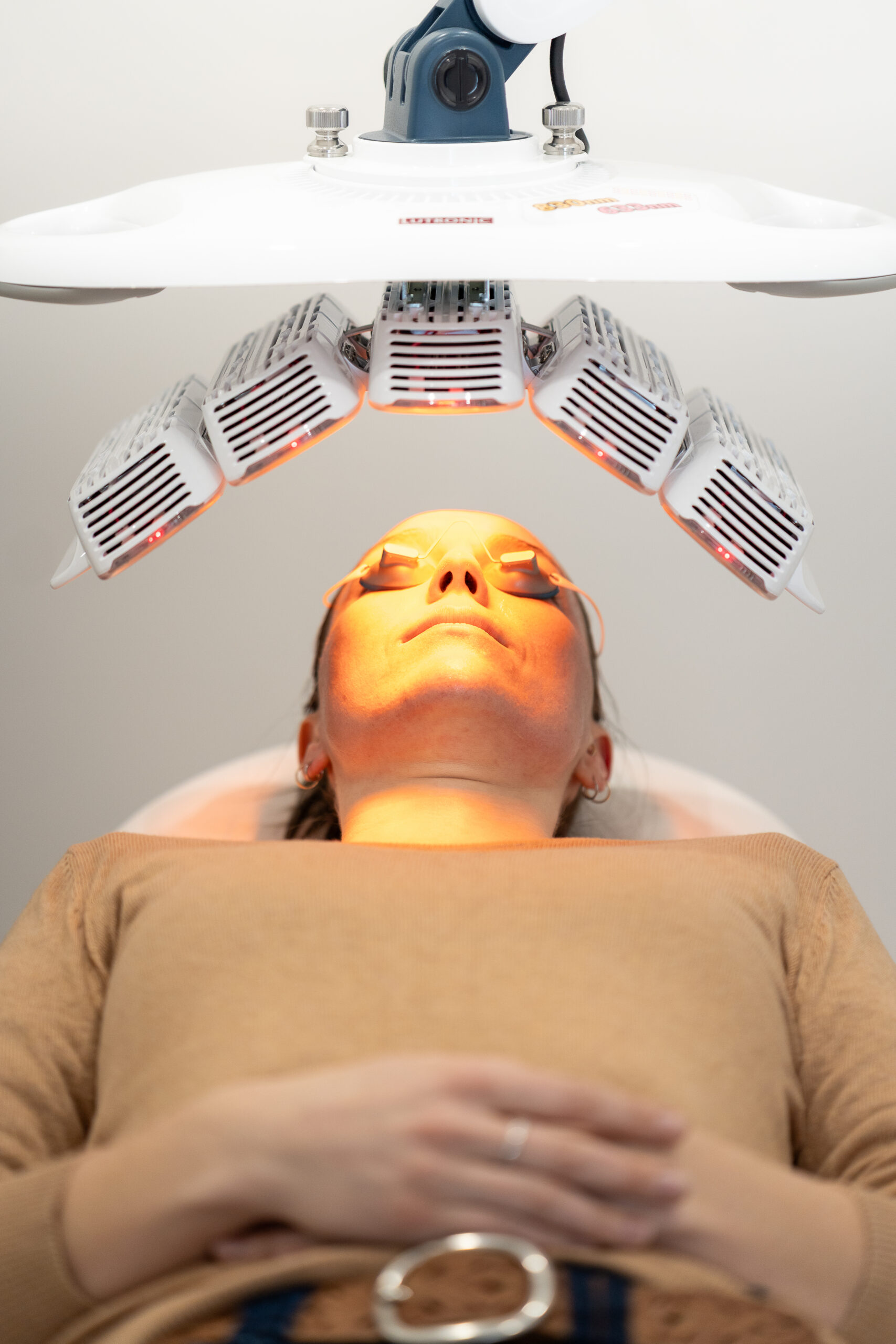
What Is LED Photobiomodulation?

LED photobiomodulation uses specific wavelengths of red and near-infrared light to influence cellular activity without intentionally damaging or removing the skin.

Unlike laser resurfacing, LED does not work by creating controlled injury. Instead, light energy interacts with cellular pathways involved in signalling, metabolism and tissue response.

At Arnprior Med Spa, we use the Lutronic Healite II with two important wavelengths:

633 nm red light — used for skin-focused photobiomodulation and to support concerns involving visible inflammation, skin quality and rejuvenation.

830 nm near-infrared light — penetrates more deeply and is commonly incorporated when supporting tissue recovery and skin following corrective procedures.

Best for

  • Post-laser skin support
  • Acne treatment support
  • Red + reactive skin
  • Skin rejuvenation
  • Hair & scalp rejuvenation
  • Post-peel + microneedling recovery

Downtime: None expected.

Why We Use Healite II Photobiomodulation

Specific Wavelengths, Selected With Purpose

Healite II allows us to use 633 nm red light and 830 nm near-infrared light according to the reason for treatment. LED is not simply “good light” — wavelength, dose and treatment protocol matter.

Supports the Skin After Corrective Treatments

We frequently incorporate photobiomodulation around treatments such as laser resurfacing, chemical peels and microneedling when appropriate. LED does not replace the corrective treatment; it serves a different role in supporting the skin through the treatment process.

No Additional Surface Injury

LED does not intentionally remove, puncture or thermally injure the skin. That makes it particularly useful when we want to support skin without adding another resurfacing procedure.

Part of a Long-Term Skin Strategy

LED may be used as a standalone treatment or integrated with skincare, acne programs and corrective procedures depending on the concern and treatment plan.

Healite II Photobiomodulation

633 nm vs 830 nm: What’s the Difference?

Healite II allows us to use specific wavelengths of red and near-infrared light according to the reason we are treating the skin. They are both forms of photobiomodulation — but they are not interchangeable.

633 nm · Visible Red Light

Skin-Focused Photobiomodulation

Red Light

633 nm is a visible red wavelength commonly used when the treatment goal is focused on skin quality, rejuvenation and supporting skin that appears inflamed or reactive.

Think
  • ✓ Overall skin quality + rejuvenation
  • ✓ Visible redness + reactive skin support
  • ✓ Inflammatory skin support
  • ✓ Acne treatment support
  • ✓ Ongoing skin-health programs
830 nm · Near-Infrared Light

Deeper Photobiomodulation + Recovery Support

Near-Infrared

830 nm is an invisible near-infrared wavelength that penetrates farther into tissue than visible red light. We often consider it when photobiomodulation is being used to support the skin around corrective treatments and recovery.

Think
  • ✓ Post-laser skin support
  • ✓ Post-microneedling support
  • ✓ Recovery-focused protocols
  • ✓ Deeper tissue photobiomodulation
  • ✓ Skin rejuvenation + tissue support
VS
Which One Is Better?

Neither. The wavelength is selected according to why we are using LED.

Photobiomodulation is dose-dependent. Wavelength, treatment intensity, exposure time and frequency all influence the treatment being delivered, which is why we use protocol-based LED rather than treating all “red light” as the same.

Professional Red Light Therapy Near Ottawa

Arnprior Med Spa offers professional Healite II LED photobiomodulation for clients looking to support skin recovery, acne treatment, visible redness and overall skin health.

Clients visit us from Ottawa, Kanata, Carp, Renfrew, Pembroke, Petawawa and throughout the Ottawa Valley.

Simple + Accessible

Healite II LED Light Therapy Pricing

Professional photobiomodulation can be booked as a standalone treatment or incorporated into a broader skin or post-procedure treatment plan when appropriate.

Standalone Treatment

Healite II Photobiomodulation

$50

A professional LED treatment using the wavelength and protocol selected for your treatment goal.

No numbing
No downtime
Standalone or adjunctive
Book Healite II LED

Frequently Asked Questions About LED + Red Light Therapy

Red light therapy uses specific wavelengths of visible red light to influence cellular activity without intentionally damaging the skin.

In medical and aesthetic literature, this is usually referred to as photobiomodulation, or PBM. Rather than resurfacing, heating or removing tissue, PBM uses low-intensity light to influence cellular signalling and metabolic activity.

At Arnprior Med Spa, we use the Healite II professional LED system, including 633 nm red light and 830 nm near-infrared light protocols.

LED light therapy uses light-emitting diodes to deliver specific wavelengths of light to the skin for photobiomodulation.

Different wavelengths interact with tissue differently, which is why we do not think of LED simply as “red light.”

The wavelength, energy delivered, treatment distance, exposure time and reason for treatment all matter.

Our Healite II protocols can incorporate 633 nm red light and 830 nm near-infrared light, depending on the treatment goal. Lutronic’s professional Healite II platform supports these wavelength configurations and uses optical technology designed to control light delivery across the treatment area.

Photobiomodulation is the scientific term for using low-intensity red or near-infrared light to influence biological activity within cells and tissues.

Research suggests that PBM can influence mitochondrial activity, cellular signalling, oxidative stress and pathways involved in tissue repair.

Importantly, it is not the same as laser resurfacing. PBM is designed to modulate cellular behaviour without intentionally creating an injury.

A 2025 expert consensus concluded that PBM is a safe treatment modality in adults when appropriately used and that red-light PBM does not induce DNA damage.

The main difference is wavelength and tissue penetration.

633 nm red light is visible and is commonly used for skin-focused photobiomodulation.

830 nm near-infrared light is invisible to the eye and reaches deeper tissue than visible red light, making it particularly useful when the goal includes deeper tissue support and recovery.

Neither is automatically “better.” We select the wavelength according to why we are using LED in the first place.

633 nm red light is used in photobiomodulation to support skin renewal, skin quality and cellular activity without creating surface injury.

Research combining 633 nm and 830 nm LED has demonstrated improvements in measures of photoaged skin, including wrinkle appearance, elasticity and collagen-related changes after a series of treatments.

At Arnprior Med Spa, 633 nm may be incorporated when the goal includes:

skin rejuvenation, visible redness or reactivity, inflammatory skin support or ongoing skin-health maintenance.

830 nm near-infrared light is used when we want photobiomodulation at a greater tissue depth.

Lutronic specifically designed Healite II around 830 nm near-infrared phototherapy and describes the wavelength as targeting dermal skin cells while supporting cellular repair and recovery.

This is one of the reasons we frequently think about 830 nm when LED is being incorporated alongside corrective procedures.

Research suggests that repeated red and near-infrared photobiomodulation can influence fibroblast activity and collagen-related remodelling.

Clinical studies using 633 nm and 830 nm LED have reported improvements in wrinkles and skin texture alongside histologic changes involving collagen and elastic fibres.

That does not mean one LED session produces the same collagen response as fractional laser resurfacing or another corrective procedure.

LED and resurfacing do different jobs.

LED can be incorporated into an acne treatment plan, but the wavelength matters.

The strongest acne-specific light evidence involves blue light or combinations of blue and red light, particularly for inflammatory acne. A 2024 systematic review found visible-light therapy may improve acne, with blue light being the most frequently studied wavelength.

When we use 633 nm red or 830 nm near-infrared LED in an acne program, we think of it more as support for inflammatory skin and recovery, rather than claiming that red light alone is treating every cause of acne.

Acne still requires a comprehensive plan addressing the type of breakouts, congestion, skincare and what the acne leaves behind.

Red and near-infrared PBM may be useful when we want to support skin that appears inflamed, reactive or temporarily sensitized without adding another surface treatment.

However, persistent facial redness can also come from visible vessels, rosacea-associated vascular changes or other causes.

LED does not replace a vascular treatment when the actual problem is a visible vessel.

This is why we assess the skin rather than assuming all redness should be treated the same way.

Yes, photobiomodulation may be incorporated after some laser procedures as an adjunct to support the skin during recovery.

Research on post-laser LED is promising but not completely uniform. Some studies have demonstrated reduced post-procedure erythema or improved recovery measures, while other trials have not demonstrated a significant advantage over placebo.

For that reason, we describe LED as recovery support, not as a guarantee that every patient will heal faster.

LED photobiomodulation may be used after fractional CO₂ resurfacing when it fits the treatment and recovery protocol.

There has been clinical research evaluating LED following fractional CO₂ resurfacing, including studies looking at post-treatment redness.

At Arnprior Med Spa, timing is determined by the procedure performed and the condition of the skin rather than automatically using the same LED schedule after every CO₂ treatment.

Potentially, yes. LED can be incorporated around different resurfacing treatments when supporting recovery is part of the plan.

The exact protocol depends on which laser was used, treatment intensity, skin response and what we are trying to accomplish.

We do not assume that because LED is gentle, more LED is always better. Photobiomodulation has a dose-dependent response, so treatment parameters matter.

LED may be incorporated after selected microneedling or chemical-peel treatments when additional photobiomodulation is appropriate.

One advantage of LED is that it does not require us to intentionally create another surface injury.

That makes it useful when we want to support the skin rather than stack another corrective treatment on top of it.

The ideal frequency depends on why you are having LED.

A dedicated photobiomodulation series may involve repeated sessions over several weeks, whereas LED used alongside laser or another procedure may follow a completely different schedule.

There is no universal rule that everyone needs LED two or three times per week.

Research consistently shows that PBM outcomes depend on parameters including wavelength, fluence, treatment duration and frequency.

LED is generally a cumulative treatment, so a series is often more meaningful than a single session when the goal is skin rejuvenation or ongoing photobiomodulation.

A classic study combining 633 nm and 830 nm LED used nine treatments over five weeks and followed subjects afterward.

That does not mean everyone at Arnprior Med Spa needs nine treatments.

Your schedule depends on whether we are using LED for rejuvenation, inflammatory skin support, recovery after another procedure or maintenance.

LED photobiomodulation does not intentionally ablate, puncture or thermally injure the skin, so it typically does not require a recovery period of its own.

Most clients can return to normal activities immediately.

If LED is performed after laser, microneedling or another procedure, however, you may still have downtime from the primary treatment.

A professional system and a quality home LED mask can both deliver legitimate photobiomodulation, so the difference is more nuanced than “clinic devices work and home masks don’t.”

Some reputable home devices use the same major wavelengths used in professional photobiomodulation.

For example, both Omnilux Contour and CurrentBody’s red-light masks use 633 nm red and 830 nm near-infrared light.

Where Healite II differs is in its role as a professional treatment platform. Depending on its configuration, Healite II provides adjustable irradiance and larger treatment-area coverage, while allowing treatment to be selected and coordinated by a provider. Its published professional specifications include adjustable intensity ranges for 633 nm and 830 nm configurations.

So our question isn’t:

“Is a clinic LED automatically better than a mask?”

It’s:

“What wavelength, dose, coverage and treatment schedule make sense for what we’re trying to accomplish?”

Both Healite II and Omnilux can use clinically established red and near-infrared wavelengths, but they are different types of treatment systems.

Omnilux Contour is a portable home-use device that simultaneously delivers 633 nm red and 830 nm near-infrared light at approximately 30 mW/cm².

Healite II is a professional clinic platform. Its available configurations include 633 nm and 830 nm LED heads, with adjustable irradiance ranges and a larger treatment field. Lutronic also uses its Optical Lens Array Technology to control light delivery across the treatment area.

That doesn’t make Omnilux a poor device.

It makes professional Healite treatment and at-home Omnilux two different ways of delivering photobiomodulation.

CurrentBody and Healite II can share some wavelengths, but their delivery systems and intended use are different.

CurrentBody’s Series 2 facial mask uses 633 nm, 830 nm and 1072 nm wavelengths with a reported power density of approximately 30 mW/cm² and is designed for regular home use.

Healite II is a professional platform with configurable wavelength heads, larger-area coverage and adjustable treatment parameters. Published Healite specifications list adjustable intensity ranges extending above those of many facial masks depending on wavelength and configuration.

For someone who enjoys consistent home LED use, a quality home mask may complement professional treatment.

For clients who enjoy consistent home LED use, a quality home device may complement professional treatment when used appropriately.

Often, a home LED device can complement professional skin care, provided the device and protocol are appropriate for you.

If you already own an Omnilux, CurrentBody or another legitimate device, bring the specifications or device information with you.

Rather than automatically telling you to stop using it, we look at the wavelengths, treatment frequency, your skin concern and what other procedures you are having. The goal is a sensible overall plan — not accumulating as many light treatments as possible.

The goal is a sensible overall plan, not accumulating as many light treatments as possible

Current evidence does not show that appropriately delivered red or near-infrared photobiomodulation causes cancer.

A 2025 evidence-based consensus concluded that red-light PBM does not induce DNA damage, while a systematic review specifically examining aesthetic PBM found no clinical evidence linking treatment to new or recurrent malignancy.

That is different from saying PBM should simply be applied over every suspicious lesion or known tumour.

If there is a known or suspected malignancy in the treatment area, medical assessment and appropriate clearance should come first.

LED should be used according to the eye-safety instructions for the specific device and wavelength being delivered.

We do not recommend staring directly into high-intensity LEDs, and eye protection or other manufacturer-directed precautions should be used when indicated.

This is particularly important because ocular safety requirements can differ between wavelengths and devices.

There is not good evidence showing that properly delivered red or near-infrared PBM automatically worsens melasma. In fact, early research has explored PBM as a possible adjunctive treatment for melasma.

A 2024 review identified studies using wavelengths including approximately 630 nm red and 830–850 nm infrared light, with preliminary findings suggesting potential effects on pigmentation, erythema and vascular features of melasma. The authors also emphasized that better clinical trials are still needed to establish optimal protocols.

For that reason, we do not position LED as a primary treatment for melasma.

At Arnprior Med Spa, melasma is treated as a chronic pigment condition requiring a broader strategy, including skincare, photoprotection, pigment control and careful selection of procedures.

Because LED photobiomodulation does not intentionally exfoliate, ablate or puncture the skin, it can be an attractive option when we want to avoid adding another surface injury.

That does not mean every person is automatically a candidate.

Photosensitivity, medications, medical conditions and the reason for treatment should still be reviewed when appropriate.

No. LED photobiomodulation and laser resurfacing are fundamentally different treatments.

A resurfacing laser delivers concentrated energy to create a controlled tissue response.

LED delivers low-intensity, non-ablative light intended to influence cellular activity without creating that same injury.

That’s why we sometimes use them together rather than viewing them as competing treatments.

No. LED cannot reproduce the tissue effects of fractional or ablative laser resurfacing.

If the concern is significant texture, wrinkles, acne scarring or photodamage requiring correction, treatments such as LaseMD Ultra, Mosaic 3D, Er:YAG or CO₂ may be more appropriate.

LED has a different role:

supporting skin biology rather than intentionally resurfacing the skin.

Yes, if photobiomodulation serves a specific purpose in your treatment plan — but it is not a substitute for good daily skincare.

Skincare, LED and corrective procedures operate through different mechanisms.

A strong plan may involve:

daily skincare for ongoing skin management, LED for photobiomodulation, and corrective procedures when we need to create a more significant tissue response.

You do not necessarily need all three.

Photobiomodulation has evidence supporting its use for androgenetic, or pattern, hair loss, although treatment protocols and devices differ significantly.

Recent systematic reviews and meta-analyses have found improvements in hair density with low-level light therapy for androgenetic alopecia.

However, hair loss can have many causes, so unexplained or sudden hair loss should not simply be assumed to be something LED can correct.

Arnprior Med Spa offers professional Healite II LED photobiomodulation in Arnprior for clients travelling from Ottawa, Kanata, Carp, Renfrew, Pembroke, Petawawa and communities throughout the Ottawa Valley.

Healite II may be booked as a standalone LED treatment or incorporated into a broader skin, acne or post-procedure treatment plan when appropriate.

Because we don’t treat LED as simply “20 minutes under a red light.”

We use photobiomodulation as part of a broader understanding of what is happening in the skin.

That means determining:

why LED is being used, which wavelength makes sense, how it fits with your skincare and procedures, and whether LED is actually the right treatment for the concern.

When LED is paired with laser resurfacing, acne treatment, microneedling or another corrective procedure, it can also be coordinated around the treatment rather than existing as an unrelated appointment.

The device matters. The protocol matters. And the reason you’re using it matters most.

Yes. Healite II has been used in published clinical studies evaluating photobiomodulation for tissue recovery, swelling, wound support and other medical applications.

For example, a 2013 clinical study specifically used Healite II at 830 nm in patients with wounds and reported improvement across the cases studied, although the sample was small and there was no control group.

A controlled study published in 2017 also evaluated Healite II using 590/830 nm in patients with facial fractures and found a greater reduction in facial swelling compared with sham treatment.

Yes. Healite II has been evaluated in randomized and placebo-controlled clinical studies, although the research is not limited to cosmetic skin rejuvenation.

A 2022 randomized, placebo-controlled study used a Healite II protocol involving 590 nm followed by 830 nm light in patients with meibomian gland dysfunction and dry-eye disease. The treatment group showed improvement in several measured clinical outcomes without serious adverse events.

No — and that is an important part of understanding photobiomodulation.

One placebo-controlled study evaluating near-infrared LED after photodynamic therapy did not find a significant reduction in redness, swelling, pigmentation or skin temperature under the protocol tested.

That tells us something valuable: photobiomodulation is dose- and protocol-dependent. The wavelength, irradiance, energy delivered, timing and condition being treated all matter.

For this reason, we describe Healite II as a treatment that may support recovery rather than promising that LED will make every procedure heal faster.

830 nm near-infrared photobiomodulation has been studied for tissue recovery, wound support and use around aesthetic or medical procedures.

Published Healite II research includes 830 nm protocols used in wound healing and tissue-recovery settings, and review literature discussing 830 nm LED as an adjunct around aesthetic procedures.

The broader photobiomodulation literature also supports the idea that near-infrared light can influence cellular signalling and tissue-response pathways, but outcomes vary according to treatment parameters.

At Arnprior Med Spa, that is why we use protocol-based LED rather than treating all “red light” as equivalent.

Give Your Skin Recovery Time — With Support